

Pride Never Dies: The Untold Rise, Reign, and Fall of Japan’s Most Spectacular Fight Empire
The Pride Fighting Championships didn’t just shape an era of MMA — it defined one. Emerging in the late 1990s and operating until 2007, Pride became the beating heart of Japanese combat sports, blending martial arts tradition, pro‑wrestling theatrics, and world‑class competition into a spectacle unlike anything before or since. Its influence still echoes through modern MMA, carried by the legends it produced and the unforgettable moments it staged.
The Birth of a Colossus: Pride’s Roots in the Late 1990s
Pride’s origins trace back to Japan’s booming combat‑sports culture of the late 90s, where pro‑wrestling pageantry collided with real martial arts rivalry. The organization emerged from a desire to showcase Japanese fighting spirit against the rising wave of Brazilian talent — especially the dominance of the Gracie family.
This cultural fusion created a promotion that felt both theatrical and authentic. Pride wasn’t just a fight organization; it was a national statement, a stage where martial arts philosophies clashed under blinding lights and roaring crowds.
The Golden Era: Pageantry, Power, and the 2000 Grand Prix
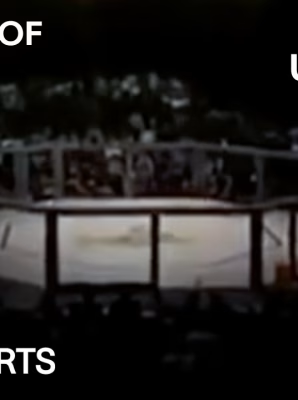
By the early 2000s, Pride had transformed into a global juggernaut. The 2000 Grand Prix marked its arrival as the world’s premier MMA spectacle. Everything about Pride was larger than life — the booming theme music, the laser‑lit walkouts, the towering white ring, and the electric energy inside packed Japanese stadiums.
This era produced some of the most iconic visuals in combat sports history. Fighters didn’t just compete; they performed. Pride’s presentation elevated every bout into a mythic event, and fans worldwide were hooked.
Icons of Violence: The Fighters Who Defined Pride
Wanderlei Silva
Few fighters embodied Pride’s ferocity like Wanderlei “The Axe Murderer” Silva. His reign in the middleweight division became synonymous with brutality — a whirlwind of knees, stomps, and merciless aggression. Silva’s rivalries and finishes helped cement Pride’s reputation for unrestrained, high‑octane combat.
Don Frye vs. Yoshihiro Takayama
One of the most legendary brawls in MMA history erupted when Don Frye and Yoshihiro Takayama locked horns. Their opening clinch — a mutual exchange of nonstop punches — became an immortal moment, a raw display of toughness that transcended technique and entered folklore.
Fedor Emelianenko
Pride’s heavyweight king, Fedor Emelianenko, dominated with an aura of invincibility. Calm, expressionless, and ruthlessly efficient, Fedor dismantled elite opponents with seamless transitions between striking and grappling. His run in Pride remains one of the greatest heavyweight streaks ever recorded.
Mauricio “Shogun” Rua
Shogun Rua emerged as one of Pride’s most dynamic talents, blending Muay Thai violence with fluid movement and relentless pressure. His victories over top contenders showcased a new generation of Brazilian fighters ready to redefine the sport.
Behind the Curtain: Controversy, Crisis, and Collapse
Despite its global success, Pride’s empire was built on unstable foundations. The organization faced mounting controversy as reports surfaced of hidden ties to the Yakuza, sparking internal turmoil and public scrutiny. Television networks severed relationships, sponsorships evaporated, and the financial structure began to crumble.
By 2007, the once‑unstoppable titan was forced to sell its assets to the UFC. The ring went dark, the theme music faded, and an era ended.
A Legacy That Refuses to Die
Though Pride closed its doors, its spirit never left the sport. The organization’s influence lives on through its fighters, its unforgettable rivalries, and the stylistic innovations it introduced. Fans still celebrate Pride’s rule set, its theatrical flair, and the raw authenticity of its competition.
Pride wasn’t just an MMA promotion — it was a cultural phenomenon. A world where warriors became legends, where spectacle met skill, and where the impossible felt routine. Its legacy remains one of the most powerful chapters in combat sports history.
Sources
- Pride Fighting Championships — Historical Overview (Sherdog)
- Fedor Emelianenko Career Retrospective (MMA Fighting)
- Wanderlei Silva Pride Records (Tapology)
- Don Frye vs. Takayama Bout History (Bloody Elbow)
- UFC Acquisition of Pride FC (ESPN)
Article Tags
Pride FC, Japanese MMA, Fedor Emelianenko, Wanderlei Silva, Shogun Rua, Don Frye, Takayama, MMA History, Combat Sports, UFC, Yakuza Scandal, Grand Prix, Mixed Martial Arts